

Protein Sources for Pets: Chicken, Beef, Lamb, Pork and Fish Compared
Choosing the right protein sources for pets is an important part of selecting dog or cat food. Chicken, beef, lamb, pork and fish can all provide valuable nutrients, but they are not nutritionally identical. Each protein has its own amino acid profile, fat content, flavor, digestibility and role within a complete pet food formula.
Pet owners often ask a simple question: Which protein is best?
There is no single answer for every animal.
A healthy adult dog may do very well with chicken. Another pet may prefer fish. Some formulas use lamb or pork to create a different nutritional profile, while beef remains a popular choice because of its flavor and nutrient density.
At Bridge PetCare, we believe the quality of a pet food should not be judged by one ingredient alone. The most important factor is how proteins, fats, carbohydrates, vitamins and minerals work together in a complete and balanced formula.
Why Protein Matters in Pet Nutrition
Protein provides amino acids that the body uses for essential functions.
These include:
- Building and maintaining muscle
- Supporting skin and coat
- Producing enzymes and hormones
- Maintaining organs and tissues
- Supporting normal immune function
- Growth and development
- Tissue repair
Dogs and cats both require dietary protein, although their nutritional requirements are not identical.
Cats, in particular, have a strong biological dependence on animal-derived nutrients and require specific amino acids and other nutrients that must be supplied through an appropriate feline diet.
However, simply choosing a food with a high crude protein percentage does not guarantee better nutrition.
Protein quality also depends on:
- Amino acid composition
- Digestibility
- Ingredient quality
- Processing
- Nutrient balance
- The species and life stage of the animal
Therefore, pet owners should evaluate the entire formula rather than searching only for the highest protein number.
The Most Common Protein Sources for Pets
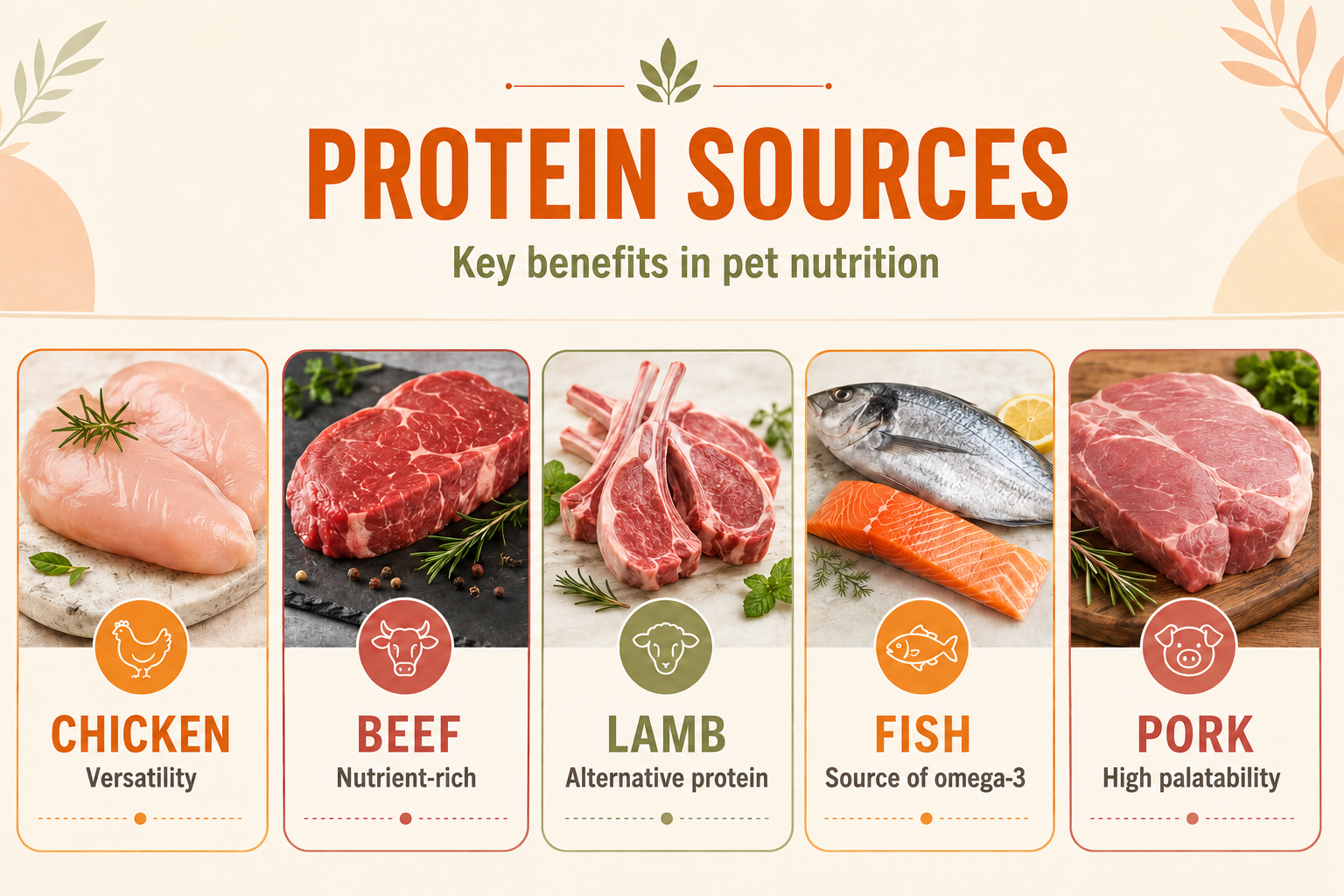
Several animal proteins are widely used in modern pet food.
Among the most important are:
- Chicken
- Beef
- Lamb
- Fish
- Pork
Each can play a valuable role when used correctly.
1. Chicken: A Versatile and Widely Used Protein
Chicken is one of the most common protein sources for pets.
It is widely used in dry food, wet food, treats and specialized formulas because it can provide high-quality animal protein and essential amino acids.
Why Is Chicken So Popular?
Chicken offers several practical advantages.
It can provide:
- Essential amino acids
- High-quality animal protein
- Good palatability
- Flexible formulation options
- Different levels of fat depending on the ingredient used
Manufacturers may use fresh chicken, dehydrated chicken, chicken meal or other properly defined poultry ingredients.
These ingredients are not nutritionally identical, so seeing the word “chicken” on the front of a package does not tell the complete story.
Is Chicken Good for Active Dogs?
Chicken can work well in formulas designed for active dogs because protein supports lean muscle maintenance and normal recovery.
However, an active dog also needs enough calories, fat, vitamins, minerals and other nutrients.
Chicken alone does not create a performance diet.
The complete nutritional profile matters more than one protein source.
What About Chicken Sensitivity?
Some pet owners avoid chicken because they believe it commonly causes allergies.
A pet can react to specific dietary proteins, but a suspected food allergy should not be diagnosed simply by observing occasional itching or digestive upset.
If a dog or cat repeatedly develops symptoms, a veterinarian may recommend a properly controlled dietary trial.
Randomly changing proteins every few weeks can make it harder to identify the actual problem.
2. Beef: Nutrient-Dense and Highly Palatable
Beef is another widely recognized animal protein used in pet food.
It can provide:
- Protein
- Essential amino acids
- Iron
- Zinc
- B vitamins
- Natural flavor
Beef can also contribute varying levels of fat depending on the cut or ingredient used.
Why Choose Beef?
Beef-based recipes may be attractive for pets that enjoy rich meat flavors.
It is frequently used in:
- Wet food
- Dry food
- High-meat formulas
- Treats
- Mixed-protein recipes
For dogs with higher energy requirements, beef ingredients with suitable fat levels may contribute to a more energy-dense formula.
However, calorie density must still match the animal’s lifestyle.
A less active pet can gain unnecessary weight if total calorie intake exceeds its needs.
Is Beef Better Than Chicken?
Not necessarily.
Beef and chicken both provide valuable animal protein.
The better option depends on:
- The complete recipe
- The animal’s tolerance
- Calorie requirements
- Fat level
- Life stage
- Digestibility
- Individual preference
Pet food should not be evaluated as a competition between individual ingredients.
3. Lamb: A Popular Alternative Protein
Lamb has become an important ingredient in many pet food formulas.
It can provide:
- Animal protein
- Essential amino acids
- Iron
- Zinc
- B vitamins
- Dietary fat
Lamb is sometimes marketed as a special or alternative protein.
However, owners should avoid assuming that lamb is automatically hypoallergenic or easier to digest than every other meat.
When Can Lamb Be a Good Choice?
Lamb may be useful when manufacturers want to create a different protein profile from common chicken or beef recipes.
It can also provide variety for pets and consumers looking for alternative animal-protein options.
Some lamb formulas are paired with ingredients such as:
- Rice
- Oats
- Sweet potato
- Vegetables
- Fish oil
The nutritional quality depends on the complete formulation.
Lamb and Sensitive Dogs
Lamb was historically used in some diets for dogs with suspected sensitivities because it was less commonly consumed in certain markets.
Today, however, lamb is widely available in commercial pet food.
Therefore, simply switching to lamb does not guarantee that a dog with suspected food allergies will improve.
Professional veterinary evaluation remains important when persistent symptoms are present.
4. Fish: Protein Plus Valuable Fatty Acids

Fish is one of the most interesting protein sources for pets because it can provide both animal protein and beneficial fatty acids.
Common fish ingredients in pet food may include:
- Salmon
- Herring
- Sardine
- Whitefish
- Tuna
- Other marine fish
Different species have different nutritional profiles.
Why Is Fish Popular in Pet Food?
Fish can contribute:
- High-quality protein
- Essential amino acids
- Omega-3 fatty acids
- Flavor
- Nutritional variety
Marine ingredients can be particularly valuable in formulas designed to support skin and coat health because certain fish oils supply EPA and DHA.
However, the amount of these fatty acids depends on the exact fish ingredient and formulation.
A package showing a salmon image does not automatically mean the product provides a meaningful level of omega-3 fatty acids.
Is Fish the Best Protein for Skin and Coat?
Fish can be useful in formulas designed with skin and coat nutrition in mind, especially when appropriate omega-3 levels are included.
But healthy skin depends on more than fish.
It also requires balanced levels of:
- Essential fatty acids
- Protein
- Zinc
- Copper
- Vitamins
- Other micronutrients
Again, the whole formulation matters.
5. Pork: An Often Overlooked Protein
Pork receives less attention than chicken, beef or salmon in pet food marketing, but it can be a valuable animal protein.
Properly processed pork can provide:
- High-quality protein
- Essential amino acids
- B vitamins
- Minerals
- Palatability
Its fat content varies significantly depending on the ingredient used.
Why Is Pork Less Common?
Consumer perception plays a role.
Chicken, beef, lamb and salmon are more familiar as premium pet food ingredients in many markets. Pork is therefore sometimes less visible on the front of premium packaging.
That does not make pork nutritionally inferior.
When properly selected, processed and incorporated into a balanced formula, pork can be a useful protein source.
Can Pork Be Used as an Alternative Protein?
In some formulas, yes.
Pork may offer manufacturers another protein option when creating recipes with different ingredient profiles.
However, as with every other meat, the nutritional value depends on the specific ingredient, processing standards and overall formula.
Which Protein Source Is Best for Dogs?
There is no universal best protein for dogs.
A healthy dog may thrive on chicken, beef, lamb, fish, pork or a combination of several proteins.
Instead of asking only:
Which meat is best?
Pet owners should ask:
- Is the food complete and balanced?
- Is it appropriate for my dog’s life stage?
- Is the protein digestible?
- Does my dog tolerate the food well?
- Is the calorie density appropriate?
- Is the manufacturer transparent?
- Are quality-control systems in place?
- Does my dog maintain healthy body and muscle condition?
These questions provide much more useful information than choosing food based only on the animal pictured on the package.
What About Cats?
Cats have different nutritional needs from dogs.
They require diets specifically formulated for feline nutrition and depend heavily on nutrients derived from animal tissues.
Chicken, beef, fish, lamb and pork may all appear in cat food, but the formula must provide essential nutrients in suitable amounts.
For example, feline diets must provide adequate taurine.
Therefore, cat owners should never assume that a bowl of cooked chicken or fish can replace a complete cat food.
A single meat ingredient is not a complete feline diet.
Single-Protein vs Multi-Protein Pet Food
Another question pet owners often encounter is whether a formula should contain one animal protein or several.
Single-Protein Formulas
These products may use one primary animal-protein source.
Potential advantages include:
- Simpler ingredient profiles
- Easier identification of major proteins
- Useful options for certain dietary strategies
However, “single protein” does not automatically mean better quality.
Multi-Protein Formulas
These formulas may combine ingredients such as:
- Chicken and fish
- Beef and chicken
- Lamb and fish
- Poultry and pork
Using several protein sources can help manufacturers create a broader amino acid profile, different flavor combinations and particular nutritional characteristics.
Neither strategy is universally superior.
The formulation should determine the choice.
Fresh Meat vs Meat Meal
The ingredient list can also create confusion.
Fresh meat and meat meal are not the same ingredient.
Fresh meat contains significant moisture.
Meat meal is a concentrated ingredient produced after much of the water and fat have been removed through controlled processing.
Because ingredients are generally listed by weight before processing, fresh meat may appear high on the ingredient list partly because of its water content.
This is why pet owners should not judge protein quality solely by the position of one ingredient.
A well-formulated product may use both fresh animal ingredients and concentrated protein ingredients.
Does More Protein Mean Better Pet Food?
Not automatically.
A label showing 35% crude protein is not necessarily better than one showing 28%.
The ideal level depends on:
- Species
- Life stage
- Activity
- Total calories
- Protein quality
- Amino acid balance
- Digestibility
- Health status
More is not always better.
The objective is to provide enough high-quality protein to meet the animal’s nutritional requirements without losing sight of the rest of the diet.
How to Compare Protein Sources for Pets
Here is a simple overview:
| Protein | Key Characteristics | Common Uses |
|---|---|---|
| Chicken | Versatile, widely used, high-quality protein | Everyday dry and wet foods |
| Beef | Rich flavor, protein, iron and zinc | Dry food, wet food and treats |
| Lamb | Alternative animal protein with good palatability | Alternative-protein formulas |
| Fish | Protein plus potential omega-3 contribution | Skin and coat, premium and specialized formulas |
| Pork | Nutritious, palatable and versatile | Alternative and mixed-protein recipes |
This table is a general comparison.
Individual ingredients vary according to quality, processing, fat content and how they are incorporated into the finished product.
How to Choose the Right Protein for Your Pet
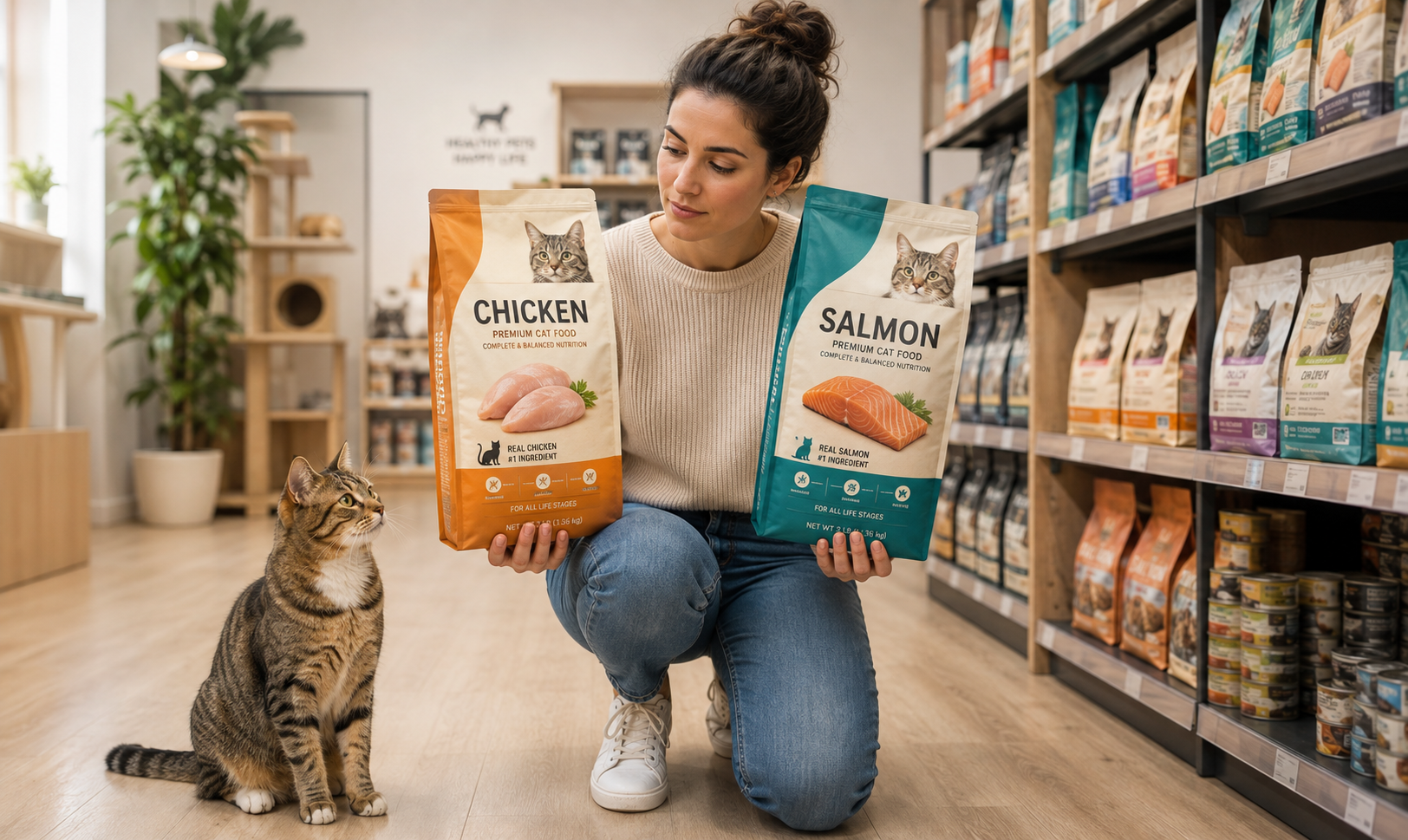
When comparing protein sources for pets, follow a practical process.
Step 1: Check Species and Life Stage
Make sure the food is intended for:
- Dogs or cats
- Puppies or kittens
- Adults
- Seniors
- Other appropriate life stages
Step 2: Read the Entire Ingredient List
Do not focus only on the first ingredient.
Look at the complete recipe and identify:
- Major animal proteins
- Fat sources
- Carbohydrate ingredients
- Functional ingredients
- Vitamins and minerals
Step 3: Review the Guaranteed Analysis
Check:
- Crude protein
- Crude fat
- Crude fibre
- Moisture
These numbers help describe the nutritional profile, but they do not measure protein quality by themselves.
Step 4: Check Calories
A nutritious food still needs to provide the correct amount of energy.
Highly active animals may require more calories, while less active pets may need careful portion control.
Step 5: Observe Your Pet
A suitable diet should help the animal maintain:
- Healthy body weight
- Good muscle condition
- Consistent stools
- Normal appetite
- Healthy skin and coat
- Appropriate energy
- Good digestive tolerance
Individual response matters.
The Bridge PetCare Approach to Animal Protein

At Bridge PetCare, we believe ingredient selection should begin with nutritional purpose.
Chicken, beef, lamb, pork and fish can all contribute valuable nutrients when they are selected carefully and used within professionally formulated pet foods.
Our approach considers:
- Ingredient quality
- Nutritional value
- Protein digestibility
- Amino acid composition
- Palatability
- Product safety
- Manufacturing consistency
- Traceability
- Species requirements
- Life-stage requirements
No single protein source defines the quality of an entire product.
The real objective is to combine ingredients in a way that provides safe, consistent and appropriate nutrition for pets.
You can learn more about Nuestras Marcas, including Vigor & Sage, Kitchen Flavor and Nature Bridge, as well as the manufacturing and quality-control systems used at the Fábrica de Bridge PetCare.
Final Thoughts: Which Protein Should You Choose?
Chicken, beef, lamb, fish and pork can all be valuable protein sources for pets.
Chicken offers versatility and broad use. Beef provides rich flavor and important nutrients. Lamb offers another animal-protein option. Fish combines protein with potentially valuable marine fatty acids, while pork can provide nutritious and palatable protein when properly formulated.
The right question is not:
“Which meat is the best?”
The better question is:
“Which complete formula best meets my pet’s nutritional needs?”
Choose food according to the animal’s species, life stage, activity, health, body condition and individual tolerance.
When a pet has persistent digestive problems, suspected allergies, chronic disease or specialized nutritional needs, consult a veterinarian or qualified veterinary nutrition professional before making major dietary changes.
Bridge PetCare — Better Nutrition Starts With Better Ingredient Understanding.